
Physiological and Perceptual Responses to Nordic Walking in a Natural Mountain Environment
31 Mar 2025
Interest around Nordic Walking (NW) has increased in recent years. However, direct comparisons of NW with normal walking (W), particularly in ecologically valid environments is lacking.
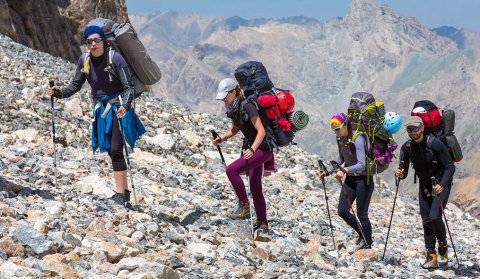
Group of 21 participants (13 male/8 female, age 41 +/- 12) were recruited, all of whom were certified Nordic Walking instructors to ensure consistent and repeatable technical execution. All 21 participants took part in the first test of the study, while a subgroup of 8 participants (4 male/4 female, age 39 +/- 10) participated in the second and third test of the study. All participants were physically active and currently engaged in regular nordic walking (NW) and ordinary walking (W).In order to provide further ecological validity with respect to performance of NW participants were allowed to use their preferred poles and to walk at a self-selected speed. This is due to it being difficult to maintain a given constant speed outdoor with different slopes and terrain both uphill and downhill, and particularly when performing a technical activity like NW.NW has become in recent years a widespread open-air physical activity but there is lack of data on the physiological stimuli induced under ecologically valid conditions.
The present study provides a first account of the physiological and perceptual response to NW compared to W in the environmental conditions where such activity is generally practised. These results obtained by our group were consistent with previous findings in more controlled environments (treadmill, artificial indoor or outdoor tracks). Taken together our data suggests that NW could be an important tool for an increase of caloric expenditure or for mild aerobic training, without any significant differences in perceived exertion.
Group of 21 participants (13 male/8 female, age 41 +/- 12) were recruited, all of whom were certified Nordic Walking instructors to ensure consistent and repeatable technical execution. All 21 participants took part in the first test of the study, while a subgroup of 8 participants (4 male/4 female, age 39 +/- 10) participated in the second and third test of the study. All participants were physically active and currently engaged in regular nordic walking (NW) and ordinary walking (W).In order to provide further ecological validity with respect to performance of NW participants were allowed to use their preferred poles and to walk at a self-selected speed. This is due to it being difficult to maintain a given constant speed outdoor with different slopes and terrain both uphill and downhill, and particularly when performing a technical activity like NW.NW has become in recent years a widespread open-air physical activity but there is lack of data on the physiological stimuli induced under ecologically valid conditions.
The present study provides a first account of the physiological and perceptual response to NW compared to W in the environmental conditions where such activity is generally practised. These results obtained by our group were consistent with previous findings in more controlled environments (treadmill, artificial indoor or outdoor tracks). Taken together our data suggests that NW could be an important tool for an increase of caloric expenditure or for mild aerobic training, without any significant differences in perceived exertion.

You may be interested in them

6 Jul 2026
What does the path to perfect technique look like? Interview with Champion Katarzyna Majewska
1 Jul 2026
Self-guided brisk walking training with or without poles: A randomized-controlled trial in middle-aged women
1 Jul 2026
Field testing of physiological responses associated with Nordic Walking

World Original Nordic Walking Federation
Administration office:
JĘDRZYCHOWSKA 20D
65-385 ZIELONA GÓRA, POLAND
office@onwf.org


© 2024 onwf.org | Original Nordic Walking from Finland